Offline Advertising SEO: How Radio, Mailers, and Billboards Drive Branded Local Search
Stop treating offline marketing and SEO as separate departments. Learn how radio, mailers, and billboards drive branded search and boost your local rankings.
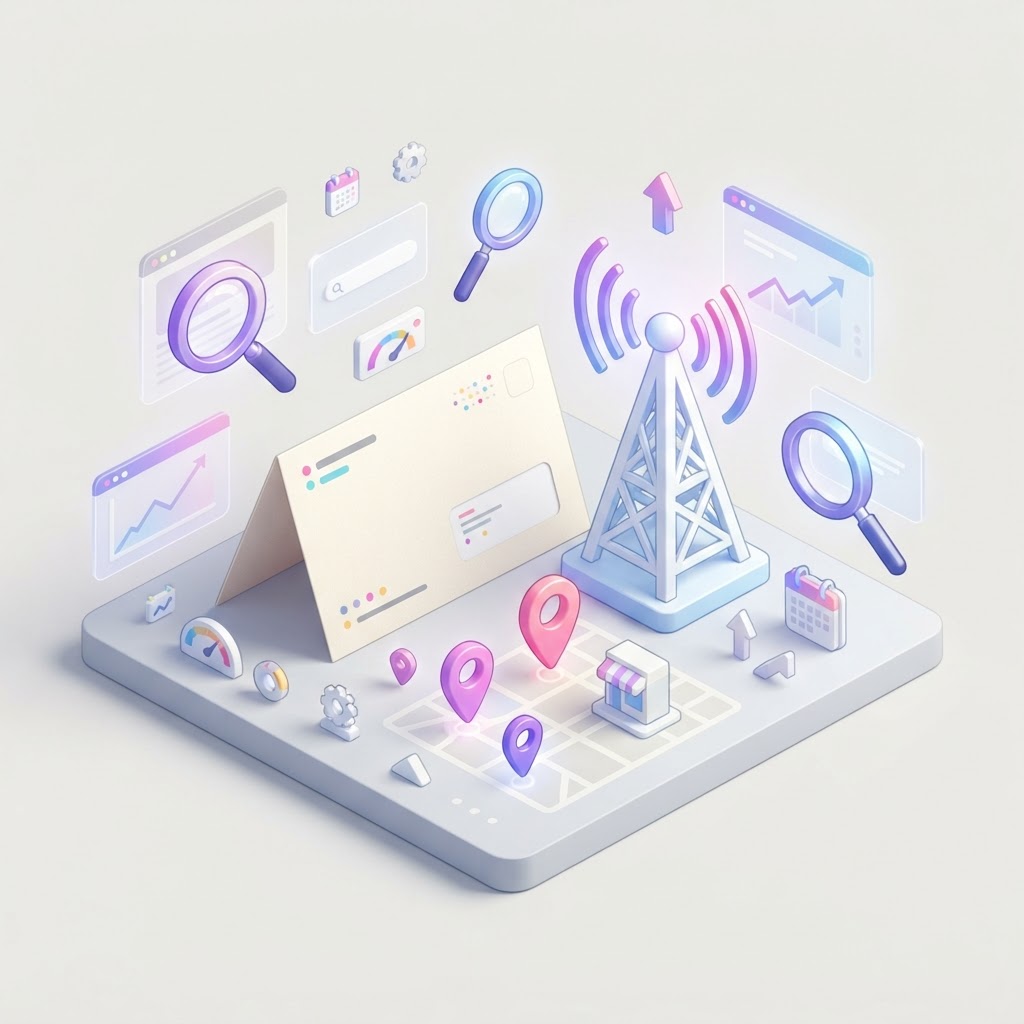
If you are spending $5,000 a month on a billboard and another $2,000 on local SEO, you probably treat them as two completely different marketing channels. One is for brand awareness; the other is for capturing demand. That is a fundamental misunderstanding of how modern search works.
Offline advertising is not dead, and it is not disconnected from your digital presence. In fact, offline advertising is one of the most powerful local SEO levers you have. When a homeowner hears your HVAC company's jingle on the radio, they do not pull over to type your exact URL into their browser. They wait until they get home, open Google, and search for your brand name.
See how clearly your website communicates your location and services.
InspectRank reviews your local visibility signals and gives you a clear, prioritized report.
Get My Free ReportThat behavior—searching for your specific business rather than a generic service—is a massive ranking signal. Here is how radio, direct mail, and billboards actually drive your local search visibility, and how to measure the impact.
The Hidden SEO Power of Branded Search
Google's algorithm is designed to surface the most prominent, trusted businesses in a local area. But how does Google know who is trusted? Backlinks and reviews are part of the equation, but Google also looks at real-world entity authority. If hundreds of people in your city are actively searching for your exact business name every month, Google takes notice.
This is known as branded search. When someone searches for "Smith & Sons Plumbing" instead of "plumber near me," they are telling Google that Smith & Sons is a recognized, sought-after entity. As your branded search volume increases, Google begins to associate your brand with the broader topic of plumbing in your city. Eventually, this authority bleeds over, boosting your rankings for non-branded, highly competitive keywords.
This is the core mechanism of Offline SEO. Traditional advertising creates the initial awareness, which triggers a branded search, which signals authority to Google, which improves your overall local rankings.
How Offline Advertising Feeds the Google Algorithm
Most advertisers fail to measure offline campaigns correctly because they look for direct, immediate conversions. But as industry data shows, billboards don't convert directly—they convert indirectly. They trigger assisted conversions.
[Original Visual Concept: A flowchart titled "The Offline-to-SEO Pipeline." It shows three stages. Stage 1: Offline Exposure (A driver sees a billboard for a local roofer). Stage 2: The Branded Search (The driver later Googles the roofer's name). Stage 3: The SEO Impact (Google registers the branded search, increasing the roofer's entity authority, leading to higher Map Pack rankings for "roof repair near me").]
When you run a direct mail campaign, a percentage of recipients will throw it away. Another percentage will keep it on their fridge. But a crucial third group will immediately Google your business to read your reviews, check your pricing, or see your past work. Even if they do not click a link on another website, this behavior acts as an unlinked brand mention, proving to search engines that your offline marketing is generating real-world interest.
How to Track Offline Advertising in Google Analytics
The biggest complaint about offline marketing is that it is impossible to track. That was true in 1995. Today, if you cannot track your offline marketing, you are simply setting it up wrong. You can measure offline advertising with Google Analytics by forcing offline users through specific digital bottlenecks.
1. Vanity URLs and 301 Redirects
Never put your homepage URL on a billboard or a direct mailer. Instead, buy a short, memorable vanity domain (e.g., GetSmithPlumbing.com) and set up a 301 redirect to a specific landing page on your main website. Attach UTM parameters to that redirect. When someone types in the vanity URL, Google Analytics will record it as campaign traffic rather than generic direct traffic.
2. Dedicated Landing Pages
If you are running a radio ad offering $50 off an AC tune-up, tell listeners to visit yourwebsite.com/radio. Make sure this page is set to "noindex" so it does not appear in organic search results. Anyone who lands on that page had to hear the radio ad. You can now track their exact behavior, time on page, and conversion rate.
See how clearly your website communicates your location and services.
InspectRank reviews your local visibility signals and gives you a clear, prioritized report.
Get My Free Report3. Offline Call Tracking
Phone calls are the lifeblood of local service businesses. Use a dedicated call tracking number for your offline campaigns. However, you must be careful not to destroy your local SEO in the process. If you publish a tracking number on a billboard, ensure it does not accidentally get scraped by data aggregators and push incorrect data to your local citations. Always understand the balance between call tracking numbers and NAP consistency.
Offline Tracking Methods Comparison
| Tracking Method | Best Used For | Pros | Cons |
|---|---|---|---|
| Vanity URLs | Billboards, Radio, TV | Easy to remember; perfectly tracks campaign traffic via UTMs. | Requires purchasing and managing additional domains. |
| Dedicated Landing Pages (/radio) | Direct Mail, Podcasts | Keeps users on your main domain; allows for tailored messaging. | Users might just Google your brand instead of typing the slash URL. |
| Promo Codes (e.g., SAVE50) | Print Ads, Mailers | Directly ties revenue to the offline campaign. | Does not track users who visit the site but fail to convert. |
| Call Tracking Numbers | All Offline Media | Captures high-intent leads; records calls for quality assurance. | Can cause NAP consistency issues if not managed properly. |
Optimizing Specific Offline Channels for Local SEO
Different offline channels drive different types of search behavior. Here is how to align your offline tactics with your local SEO strategy.
Radio and Local Podcasts
Audio advertising is entirely reliant on memory. Listeners cannot click a link, and they rarely write things down while driving. Your goal is to make your brand name unforgettable so they can search for it later. Do not waste airtime reading out a complex URL or a phone number. Spend that time hammering home your brand name and your core service. When you check Google Search Console, you should see a spike in impressions for your exact brand name during the weeks your radio flight is active.
Direct Mail and EDDM
Direct mail is highly targeted by zip code. You can use this to your advantage by creating hyper-local landing pages. If you are sending mailers to a specific neighborhood, direct them to a landing page optimized for that specific area. This not only tracks the campaign but also sends localized traffic signals to Google, reinforcing your relevance in that specific zip code.
Local Event Sponsorships
Sponsoring a local 5K, a Little League team, or a community festival is great for brand awareness, but it is also a massive link-building opportunity. Most event organizers have a website where they list their sponsors. Do not just hand over a check and a logo. Ensure you are getting a high-authority backlink to your website. This is the foundation of local sponsorship SEO, turning offline community goodwill into digital authority.
The "How Did You Hear About Us?" Failsafe
Even with vanity URLs, promo codes, and call tracking, some customers will slip through the cracks. They will see your billboard, forget the vanity URL, Google your brand name three days later, click your organic listing, and call your primary phone number. In Google Analytics, this looks like an organic search win. In reality, it was an offline advertising win.
The only way to catch this assisted conversion is to ask. Whether it is a required field on your contact form or a mandatory question your receptionists ask on every phone call, you must collect self-reported attribution data. Compare this data against your Google Analytics and Google Search Console branded search spikes to get a true picture of your offline ROI.
Conclusion
Offline advertising and local SEO are not competing for your budget; they are working together to dominate your market. Billboards, radio ads, and mailers generate the real-world awareness that drives branded search volume. That branded search volume proves to Google that you are a trusted, authoritative entity, which ultimately pushes your Google Business Profile higher in the Map Pack.
Stop treating your offline campaigns as unmeasurable brand exercises. Use vanity URLs, track your branded search impressions in Google Search Console, and start leveraging your offline marketing to feed your local SEO strategy.
Sources & references
See what InspectRank finds on your website
Get a clear report covering website SEO, technical health, local visibility and AI search readiness.
Get My Free ReportRelated guides
Local SEO for Junk Removal: Outranking National Franchises for High-Margin Cleanouts
Stop losing high-margin cleanout jobs to national franchises. Learn how independent junk removal and dumpster rental operators can use local SEO to dominate the Google Map Pack.
Local SEO for Home Inspectors: Capturing Out-of-Town Buyers and Realtor Referrals
Stop relying entirely on real estate agent referrals. Learn how home inspectors can use local SEO to capture high-intent, out-of-town buyers and dominate the Google Map Pack.
Construction Zone SEO: How to Maintain Foot Traffic When Your Street is Closed for Repairs
Don't let orange cones destroy your revenue. Learn how to use local SEO, Google Business Profile updates, and detour pages to keep customers coming during road construction.

Pricing Page Local SEO: Why Local Service Businesses Must Publish Rates to Capture High-Intent Traffic
Stop hiding your rates behind a phone call. Learn why local service businesses must publish pricing pages to capture high-intent search traffic and improve conversions.
Bilingual Local SEO: How to Rank Your Business for Spanish-Language Searches in Your City
Stop ignoring a third of your market. Learn the exact bilingual local SEO strategy to rank your business for Spanish-language searches and optimize your Google Business Profile.